
Choosing the right football boots isn't just about finding a pair that looks good or feels comfortable. The type of studs underneath your boots can make a significant difference to your grip, stability and performance on the pitch.
If you've been shopping for football boots, you've probably come across abbreviations such as FG, AG, SG, MG and TF. These refer to the playing surfaces the boots are designed for, but understanding the differences isn't always straightforward.
The wrong stud configuration can leave you slipping on wet grass, struggling for traction on artificial turf or experiencing uncomfortable levels of grip when turning.
In this guide, we'll explain the different types of football boots, which surfaces they're suitable for and how to choose the right pair for where you play.
What Do FG, AG and SG Mean on Football Boots?
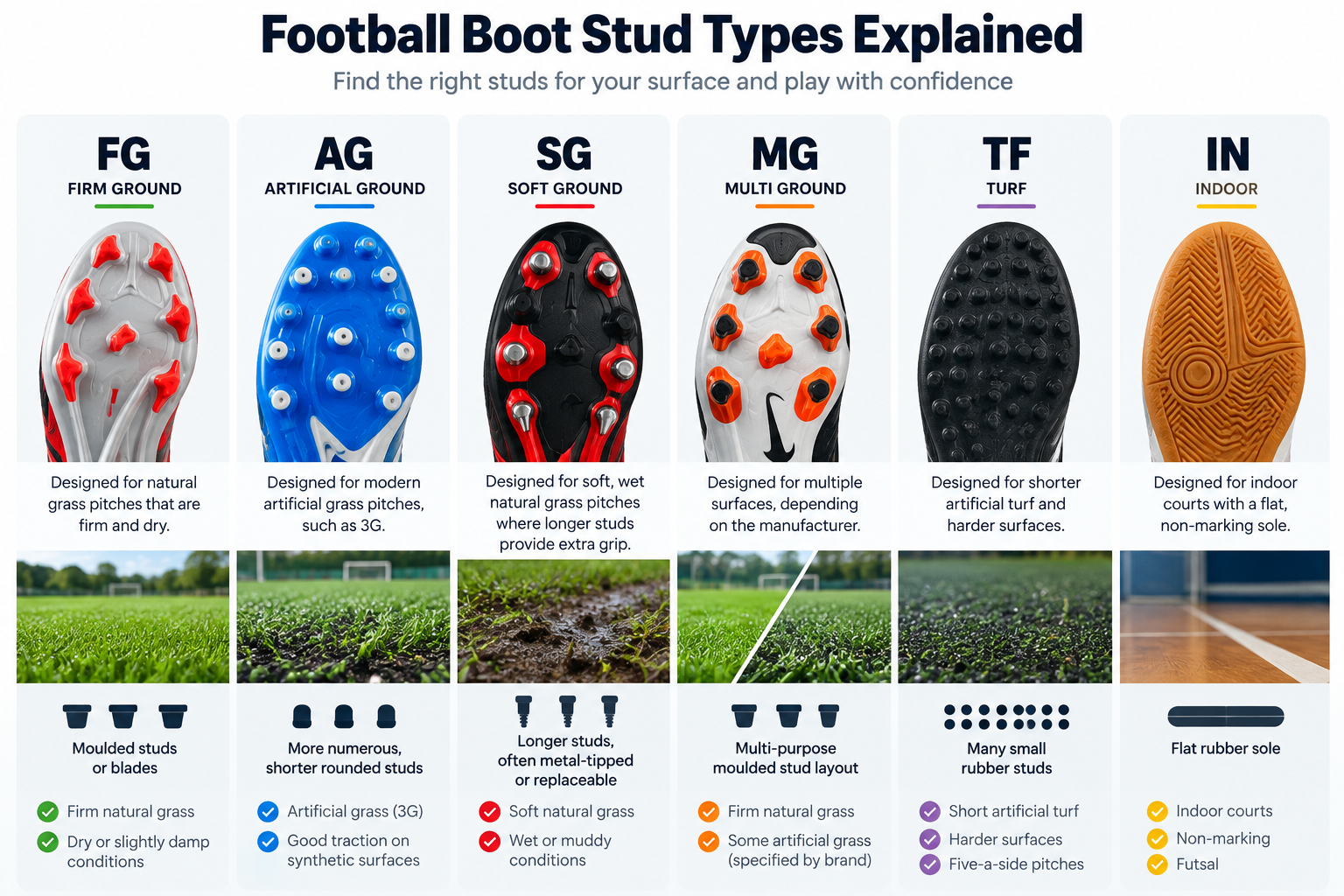
FG, AG and SG are abbreviations used by football boot manufacturers to describe the type of ground their boots are designed for.
- FG (Firm Ground): Designed primarily for natural grass pitches that are relatively firm and dry.
- AG (Artificial Ground): Designed for suitable artificial grass surfaces, typically modern 3G pitches.
- SG (Soft Ground): Designed for wet, soft natural grass pitches where longer studs are needed for traction.
- MG (Multi Ground): Designed for multiple surfaces specified by the manufacturer, often including firm natural grass and certain artificial grass pitches.
- TF (Turf): Designed for shorter artificial turf and harder surfaces, using numerous small rubber studs.
- IN (Indoor): Designed for indoor courts, generally featuring flat, non-marking rubber outsoles.
Although some football boots are marketed as suitable for more than one surface, not every soleplate is interchangeable.
Understanding these differences is particularly important if you regularly switch between natural grass and artificial pitches.
Football Boot Stud Types Compared
| Boot Type | Best Suited For | Stud Configuration | Main Advantage |
|---|---|---|---|
| FG | Firm natural grass | Moulded studs or blades | Grip and stability on firm grass |
| AG | Suitable artificial grass | Typically numerous shorter, rounded studs | Traction designed for artificial grass |
| SG | Soft, wet natural grass | Longer studs, often metal-tipped or replaceable | Penetration and grip on soft ground |
| MG | Manufacturer-approved multiple surfaces | Multi-purpose moulded stud layout | Versatility |
| TF | Short artificial turf and hard pitches | Many small rubber studs | Grip on shallow turf |
| IN | Indoor sports courts | Flat rubber sole | Court traction without studs |
The right option depends on the actual playing surface, its condition and the manufacturer's guidance for the specific boot.
What Are FG Football Boots?
Firm ground football boots are among the most common types of boots sold in the UK.
They're designed primarily for natural grass pitches that are reasonably firm underfoot. This includes many outdoor football pitches during dry weather or periods when the ground hasn't become particularly soft.
FG boots usually feature moulded plastic studs, although their shape and arrangement vary considerably between manufacturers and models.
Some have predominantly conical studs, while others feature more aggressive blade-shaped configurations.
When Should You Wear FG Football Boots?
FG boots are generally suitable for:
- Natural grass pitches during dry or moderately damp conditions
- Firm grass surfaces where longer studs aren't necessary
- Outdoor football played on well-maintained natural grass
They are not automatically suitable for artificial grass.
Some manufacturers approve particular FG or FG/MG models for specific artificial surfaces, but you should never assume that all firm-ground boots can be used safely on 3G pitches.
Can You Wear FG Boots on Artificial Grass?
This is one of the most common questions footballers ask.
The answer depends on the particular boots, the type of artificial pitch and the manufacturer's instructions.
Some FG soleplates can create excessive traction on artificial surfaces, particularly configurations with longer or more aggressive studs. This may make it harder for the foot to release naturally when turning.
If you regularly play on artificial grass, a dedicated AG boot or an explicitly approved MG model is generally a more appropriate starting point.
You should also check the pitch operator's footwear rules, as some facilities restrict particular stud types.
What Are AG Football Boots?
Artificial grass football boots are designed specifically for compatible artificial grass pitches.
Modern 3G football pitches typically use synthetic grass fibres with a performance infill system, although their construction and maintenance can vary.
AG boots commonly have a greater number of shorter studs distributed across the soleplate. Many use rounded stud shapes intended to provide traction without the same degree of penetration as traditional soft-ground studs.
The precise design varies between brands.
Why Choose AG Boots?
The main advantage of AG boots is that their outsole is designed around the demands of artificial grass.
Compared with an unsuitable natural-grass soleplate, an appropriate AG design can provide a better balance between grip and foot movement.
AG boots are worth considering if:
- You play five-a-side, seven-a-side or eleven-a-side on suitable 3G pitches
- Most of your matches or training sessions take place on artificial grass
- You want a boot designed specifically for that playing surface
- Your pitch operator recommends or requires AG-compatible footwear
However, AG boots are not necessarily suitable for every artificial surface.
Older, short-pile pitches and some 2G facilities may require turf shoes rather than conventional AG boots.
Are AG Boots Suitable for 4G Pitches?
The term 4G is widely used in the UK, but it isn't a consistent technical classification of football pitch construction.
Different facilities may use the term to describe different artificial surfaces.
Rather than choosing footwear based only on whether a pitch is advertised as 3G or 4G, check the actual surface specification and the venue's footwear guidance.
What Are SG Football Boots?
Soft Ground football boots are designed for natural grass pitches that are wet, muddy or particularly soft.
They're most useful when the ground is soft enough for longer studs to penetrate and provide additional traction.
SG boots frequently feature fewer, longer studs than FG boots. Some models use removable metal-tipped studs, while others combine longer studs with moulded elements.
When Should You Wear SG Football Boots?
SG boots are generally best for:
- Wet natural grass pitches
- Muddy winter football conditions
- Soft ground where FG studs struggle to provide enough grip
They're particularly useful during periods of heavy rain when natural pitches become slippery and unstable.
However, SG boots are not the best choice simply because the grass is wet. If the ground underneath remains firm, FG boots may still be more appropriate.
Can You Wear SG Boots on Artificial Grass?
Generally, no.
Traditional SG boots with long or metal-tipped studs are not intended for artificial grass surfaces and are commonly prohibited by pitch operators.
Their stud design can be unsuitable for the surface and may increase the risk of excessive traction, discomfort or surface damage.
Use footwear specifically approved for the artificial pitch instead.
What Are MG Football Boots?
Multi Ground football boots are designed for use across more than one playing surface.
They can be particularly appealing to amateur footballers who train on artificial grass during the week but play matches on natural grass at weekends.
However, MG does not mean that a boot is suitable for every surface.
The surfaces approved for MG boots vary between manufacturers and models.
Some FG/MG boots are designed for firm natural grass and certain artificial grass surfaces, while other multi-ground designs have different intended uses.
Always check the manufacturer's surface recommendations before buying.
Are MG Boots Worth Buying?
If you regularly alternate between compatible natural and artificial grass pitches, MG boots can offer a convenient alternative to owning multiple pairs.
They may not deliver the same specialised performance as dedicated AG or SG boots in more demanding conditions, but their versatility makes them a practical option for many recreational players.
What Are TF Football Boots?
Turf football boots are designed for shorter artificial turf and some harder playing surfaces.
Instead of traditional football studs, they feature numerous small rubber protrusions across the outsole.
This helps distribute contact over the surface while providing traction suited to shallow artificial turf.
TF boots are commonly used for:
- Older, short-pile artificial pitches
- Certain five-a-side football facilities
- Harder artificial playing surfaces where traditional studs are unsuitable
They're not necessarily the best option for every modern long-pile 3G pitch, so check the facility's footwear guidance.
FG vs AG Football Boots: Which Are Better?
Neither FG nor AG boots are universally better. They're designed for different surfaces.
If you play almost exclusively on natural grass that is usually firm, FG boots are generally the more suitable choice.
If you regularly play on a compatible artificial grass pitch, dedicated AG boots are usually worth prioritising.
If you split your time between the two, a manufacturer-approved MG or FG/AG model may offer the flexibility you need.
The most important factor is matching the soleplate to the surface rather than choosing based on the appearance of the boots.
Can You Wear the Same Football Boots on Grass and Artificial Grass?
Sometimes, but not always.
Certain multi-ground football boots are specifically designed for use on both firm natural grass and compatible artificial grass.
However, traditional FG, AG and SG boots should not automatically be treated as interchangeable.
Before buying one pair for multiple pitches, consider:
- Which surface you play on most frequently
- Whether the artificial pitch permits your chosen soleplate
- Whether the manufacturer approves the boot for both surfaces
- How wet or soft your natural grass pitch becomes
- Whether owning separate pairs would be more practical
For players who spend most of their time on artificial grass, a dedicated AG pair can be a worthwhile investment.
For players competing regularly on very soft natural grass, having separate SG boots for wet conditions may also be useful.
How to Choose the Right Football Boots
Once you've identified the correct soleplate, there are several other factors worth considering.
Fit and Comfort
Football boots should feel secure without causing excessive pressure.
Different models can have different shapes, toe-box widths and levels of flexibility. A boot that suits one player may feel uncomfortable for another. If you are looking for football boots for wide feet, consider fit alongside your playing surface.
Try boots with the socks you normally wear for football, and avoid relying on the assumption that uncomfortable boots will eventually stretch enough to fit.
Playing Position and Style
Some football boots are marketed around speed, control or comfort.
These features can influence your preferences, but there's no rule that strikers must wear speed boots or defenders must wear control boots.
Fit, traction and comfort are more important than choosing a model simply because it's marketed towards your position.
Budget
You don't necessarily need the most expensive football boots to perform well.
Entry-level and mid-range boots can provide excellent value, particularly for recreational players.
Premium boots may offer lighter materials, different construction methods and more specialised features, but they're not automatically the best choice for every footballer.
Comparing prices across retailers can help you find the same model for less.
Size Availability
Football boot sizing can differ between brands and even between models from the same manufacturer.
Check the size guide for the exact product and consider trying the boots on where possible.
When comparing prices online, make sure the advertised price applies to your size, as some retailers discount individual sizes more heavily than others.
Find the Right Football Boots for Your Pitch
Choosing between FG, AG, SG, MG and TF boots doesn't have to be complicated.
The key is to start with the surface you play on, then narrow down your options by fit, budget and personal preference.
FootyDirect's Football Boot Finder helps you narrow down suitable boots based on your playing surface, size, budget and preferences.
You can then compare available retailer prices to see which shops offer the best deal for your chosen boots.
You can also explore football boots by brand, including adidas, Puma and New Balance, and compare available prices across retailers.
Frequently Asked Questions
Are FG and AG football boots the same?
No. FG boots are primarily designed for firm natural grass, while AG boots are designed for compatible artificial grass pitches. Their stud patterns and intended playing surfaces differ.
Can you wear FG football boots on 3G pitches?
Only where the particular boot is approved for that surface and the pitch operator permits it. Some FG configurations are unsuitable for artificial grass, so dedicated AG or approved MG footwear is generally a safer starting point.
Are SG boots better for wet weather?
SG boots can provide better traction on soft, muddy natural grass because their longer studs penetrate the ground. However, if the surface remains firm despite being wet, FG boots may still be suitable.
What football boots should you wear on 4G pitches?
Because 4G is not a standardised description of pitch construction, check the venue's footwear requirements. Depending on the actual surface, AG, MG or TF boots may be recommended.
Can you wear AG boots on natural grass?
Some AG models may be suitable for certain natural grass conditions if the manufacturer approves them, but dedicated AG boots are primarily intended for artificial surfaces. Check the specific model's guidance.
What is the difference between MG and FG football boots?
FG boots are primarily intended for firm natural grass, whereas MG boots are designed for multiple manufacturer-approved surfaces. The exact permitted surfaces depend on the model.
What boots should you wear for five-a-side football?
It depends on the pitch. Indoor courts generally require IN shoes, short artificial turf may call for TF shoes, and some longer-pile artificial grass pitches permit AG or approved MG boots. Always check the facility's rules.
Final Thoughts
Understanding football boot stud types is one of the most important parts of choosing the right footwear.
FG boots are designed primarily for firm natural grass, AG boots for compatible artificial grass, and SG boots for soft natural pitches. MG boots offer versatility across specified surfaces, while TF and IN footwear are intended for different artificial or indoor environments.
Before purchasing, check the manufacturer's guidance and the footwear rules for your pitch.
Once you know which soleplate you need, FootyDirect can help you compare football boots from different retailers and find a suitable pair at a competitive price.